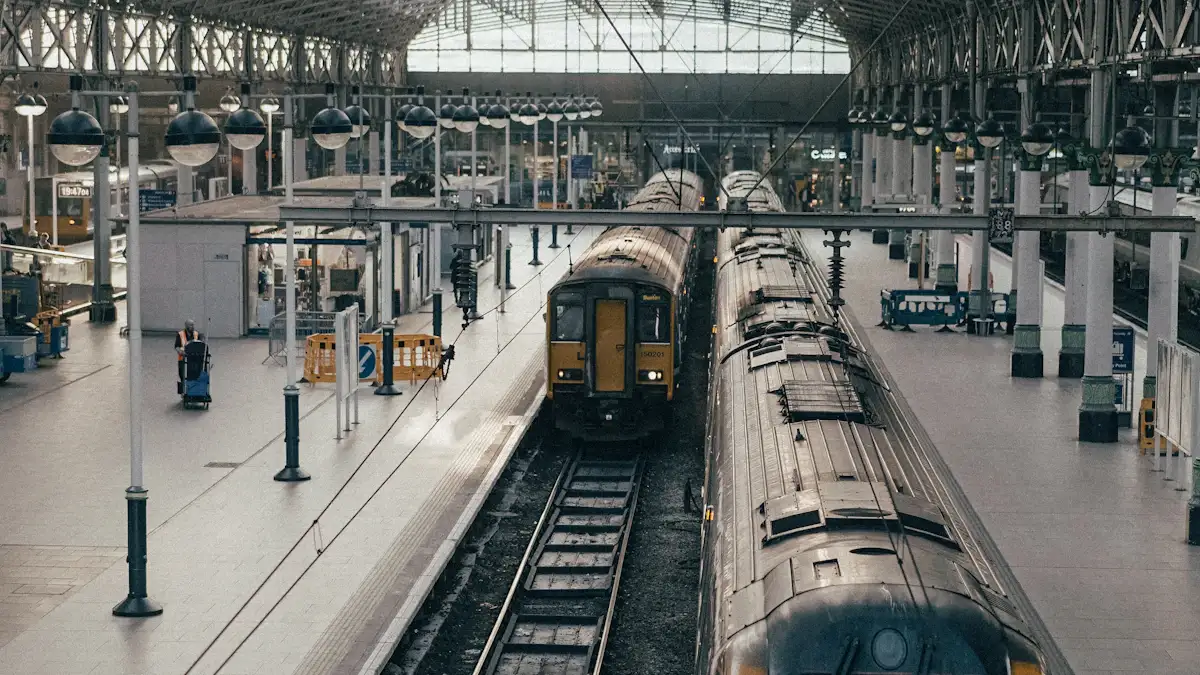
Traveling by train is one of the great pleasures of a European trip. Trains take you from city center to city center, skip the airport security lines and let you watch vineyards, mountains and coastlines roll past your window. With high-speed lines now connecting many major cities, rail is often as fast as flying on routes under about four hours.
This guide explains how European trains work, when a rail pass makes sense and how to find cheap tickets.
Why Choose the Train Over Flying?
- City-center stations: no long transfers from distant airports.
- Less waiting: most trains require you to arrive only a few minutes before departure.
- Generous luggage: you can usually bring more bags than on a budget airline, with no extra fees.
- Comfort: more legroom, the freedom to walk around and often a café car.
- Lower emissions: rail travel produces far less carbon than a short-haul flight.
Types of Trains in Europe
High-Speed Trains
These operate at speeds of up to 186 mph (300 km/h) and usually require a seat reservation. Well-known services include:
- TGV inOui and Ouigo in France, with Ouigo being the budget option
- Frecciarossa and Italo in Italy
- ICE in Germany
- AVE and Iryo in Spain
- Eurostar, connecting London with Paris, Brussels and Amsterdam
Regional Trains
Slower regional trains stop at smaller towns and usually have fixed prices that do not change with demand. Seat reservations are rarely needed, making them flexible for day trips.
Night Trains
Overnight sleeper trains have made a comeback, with routes such as Vienna to Venice, Paris to Berlin and Brussels to Prague. Sleeping on the train saves the cost of one night's accommodation and a day of travel.
Popular Train Routes in Europe
- London to Paris: about 2 hours 20 minutes by Eurostar
- Paris to Amsterdam: about 3 hours 20 minutes
- Rome to Florence: about 1 hour 30 minutes
- Florence to Venice: about 2 hours
- Madrid to Barcelona: about 2 hours 30 minutes
- Zurich to Milan: about 3 hours 20 minutes through the Alps
- Vienna to Salzburg: about 2 hours 30 minutes
Journey times vary by service, so check the specific train when booking. Planning Italy? See our Rome, Florence and Venice itinerary.
Point-to-Point Tickets vs. Rail Passes
Point-to-Point Tickets
High-speed tickets work much like airline fares: prices rise as the travel date approaches and seats sell out. Booking early, often two to three months ahead, can secure very low fares. Buy directly from national operators such as SNCF Connect, Trenitalia, Italo, Deutsche Bahn, Renfe or Eurostar.
Eurail Pass
A Eurail Global Pass (or Interrail for European residents) allows unlimited train travel across more than 30 countries for a set number of days. A pass can be good value if you:
- Plan several long journeys in a short period
- Want flexibility to change plans at the last minute
- Are traveling in countries with expensive walk-up fares, such as Switzerland, Germany or Austria
Keep in mind that most high-speed and night trains require paid seat reservations even with a pass. Compare the pass price with the cost of buying individual tickets in advance before deciding.
Country Passes
Some countries have their own passes. The Swiss Travel Pass, for example, includes trains, buses, boats and many museums. Learn more in our Switzerland travel guide.
Tips for Train Travel in Europe
- Check the station name: large cities have several stations. Paris alone has six major terminals.
- Arrive early for Eurostar: it has airport-style security and passport checks.
- Validate paper tickets: in Italy and some other countries, open regional tickets must be validated before boarding.
- Find your coach number: platform signs often show where each carriage will stop.
- Watch your luggage: keep valuables with you and use the racks near your seat.
- Download the apps: operator apps show live platform changes and delays.
When Flying Is Better
For very long distances, such as Lisbon to Prague or London to Athens, flying is usually faster and cheaper. A good approach for a multi-country trip is to fly across the Atlantic into one city, use trains for nearby destinations and take a short flight for the longest leg. Compare fares for both on SkylineSparrow flights.
Frequently Asked Questions
Is it cheaper to travel Europe by train or plane?
On routes under four hours, booked in advance, trains are often similar in price once you add airport transfers and baggage fees. For long distances, budget flights are usually cheaper.
Do I need to reserve seats on European trains?
High-speed, international and night trains usually require reservations. Most regional trains do not.
Can I buy train tickets at the station?
Yes, but high-speed fares are typically much more expensive on the day. Book online in advance for the best prices.
All Aboard
Rail travel turns the journey itself into part of the adventure. Combine trains with smart flight choices, compare hotels near major stations on SkylineSparrow and enjoy seeing Europe at ground level.